

Walk past any construction site and you’ll see freshly poured concrete, columns taking shape, and slabs being cast. Everything may look solid from the outside.
But here’s the question every builder, contractor, engineer, and property owner should ask:
Is the concrete actually achieving the strength required for the structure?
Concrete may look strong within a few days, but appearance alone doesn’t tell the full story. That’s why engineers rely on Concrete Cube Testing to verify whether the concrete is performing as expected.
In construction, assumptions can be expensive. A simple test today can help prevent major structural concerns tomorrow.
What Is Concrete Cube Testing?
Concrete Cube Testing is one of the most common quality checks performed during construction.
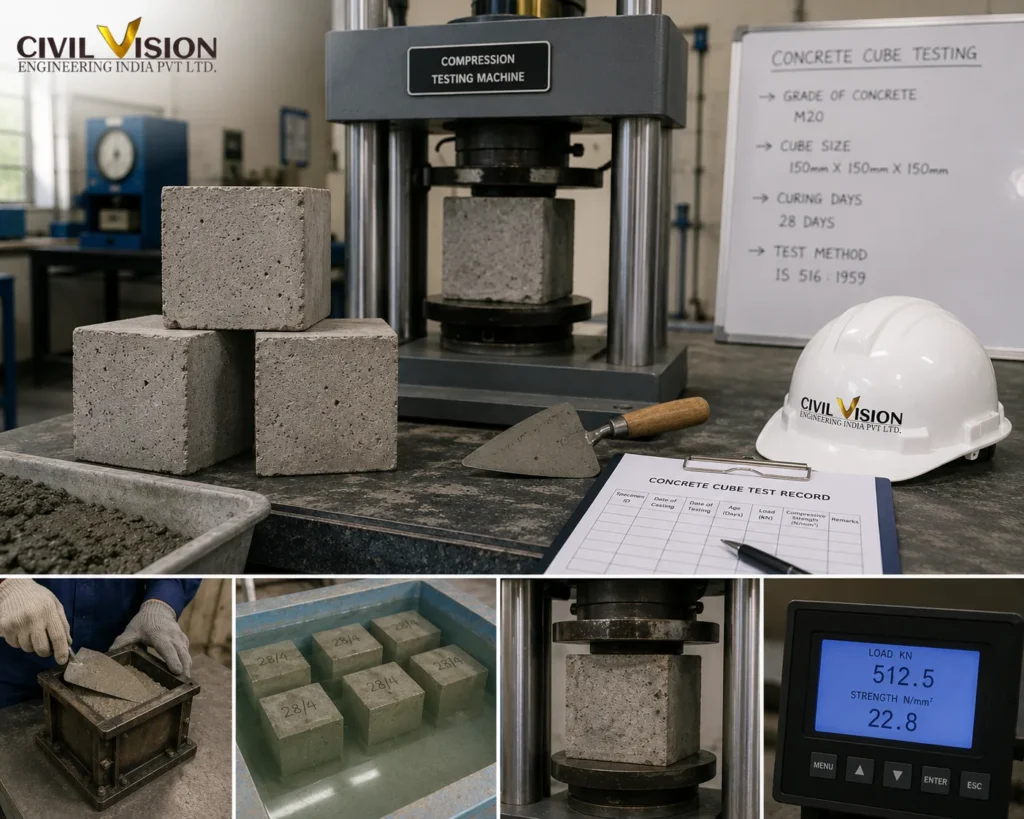
The process involves collecting concrete samples during pouring, casting them into cube moulds, curing them under controlled conditions, and testing them using a compression testing machine.
The purpose is simple — to determine whether the concrete has achieved the required compressive strength.
This test plays a crucial role in ensuring the safety, durability, and long-term performance of a structure.
Why Is Concrete Cube Testing Important?
any construction issues don’t become visible immediately.
A building may look perfectly fine during construction but develop problems later if the concrete fails to achieve the required strength.
Concrete Cube Testing helps identify potential issues before they become costly problems.
It provides confidence that the concrete being used on-site meets design requirements and quality standards.
What Can a Cube Test Tell You?
A concrete cube test helps engineers understand:
- Whether the concrete mix is performing as expected
- If the required compressive strength has been achieved
- The overall quality of concrete used on-site
- Whether corrective actions are required
- Whether construction can proceed safely
For engineers and project owners, this information is critical for maintaining quality control throughout the project.
How Is Concrete Cube Testing Performed?
The testing process generally includes:
1. Sample Collection
Concrete samples are collected during pouring.
2. Cube Casting
The concrete is placed into standard cube moulds and compacted properly.
3. Curing Process
The cubes are stored under controlled conditions to allow proper curing.
4. Compression Testing
The cubes are tested using a compression testing machine at specific intervals, usually after 7 days and 28 days.
5. Test Report
The results are compared against the specified concrete grade and project requirements.
Why Are 7-Day and 28-Day Tests Important?
You’ll often hear engineers talking about 7-day and 28-day cube test results.
1) 7-Day Test
Provides an early indication of concrete performance.
2) 28-Day Test
Considered the standard reference for determining the final compressive strength of concrete.
The 28-day result is generally used to verify whether the concrete has met design requirements.
Common Reasons for Low Concrete Strength
Several factors can affect concrete performance:
1. Excess Water in the Mix
Too much water can reduce concrete strength significantly.
2. Poor Quality Materials
Low-quality cement, aggregates, or sand can affect overall performance.
3. Improper Mixing
Inconsistent mixing can lead to variations in concrete quality.
4. Inadequate Curing
Poor curing practices often result in lower strength development.
5. Incorrect Concrete Proportions
Improper mix design can impact both strength and durability.
What Happens If a Cube Test Fails?
A failed cube test doesn’t automatically mean the structure is unsafe.
However, it does indicate the need for further investigation.
Engineers may recommend:
- Additional testing
- Core testing
- NDT testing
- Structural assessment
- Corrective measures if required
The goal is always to understand the actual condition of the concrete before making decisions.
Who Should Consider Concrete Cube Testing?
Concrete Cube Testing is important for:
- Residential construction projects
- Apartment developments
- Commercial buildings
- Industrial facilities
- Warehouses
- Infrastructure projects
- Educational institutions
- Hospitals
Any project that uses concrete can benefit from proper quality testing.
Why Concrete Cube Testing Matters in Bangalore
Bangalore continues to see rapid growth in residential, commercial, and infrastructure development.
With construction projects becoming larger and more complex, maintaining quality control is more important than ever.
Concrete Cube Testing helps builders, contractors, consultants, and project owners ensure that structures are built using concrete that meets the required strength standards.
A small investment in testing can help avoid expensive repairs, delays, and quality concerns later.
Strong Buildings Start with Strong Concrete
Concrete is one of the most important materials used in construction, and its performance directly affects the safety and durability of a structure.
While concrete may look strong on the surface, only proper testing can confirm whether it has achieved the required strength.
That’s why Concrete Cube Testing remains one of the most important quality checks in modern construction. It helps project teams make informed decisions, maintain quality standards, and build with confidence from the very beginning.
Contact Civil Vision Bangalore for today for expert soil testing, structural design, NDT services, 3D modeling and structural engineering services.
FAQs
1. What is the purpose of concrete cube testing?
Concrete Cube Testing is conducted to determine the compressive strength of concrete and verify whether it meets project requirements.
2. When is concrete cube testing performed?
Cube testing is commonly performed at 7 days and 28 days after casting.
3. What is the standard size of a concrete cube?
The standard cube size is typically 150 mm × 150 mm × 150 mm.
4. Why is the 28-day cube test important?
The 28-day test is considered the standard reference for evaluating the final strength of concrete.
5. Can construction continue if a cube test fails?
The next steps depend on the test results. Engineers may recommend additional investigations such as NDT testing or core testing before making decisions.